In short: in the first week, buy only the items you can unbox and use in five minutes. A broom and dustpan set, a dish drying rack, and a surge protector with a long cord all pass. A sofa and a smart thermostat do not. Anything that needs a drill, a schedule, or a second trip to the store belongs on the week-two list.
We write buying guides, not reviews, and nothing on this page was unboxed or handled by us. Specifications come from the manufacturer or the listing, and whatever a retailer shows when you click is the authoritative figure.
Moving turns ordinary shopping into a scramble. The stores are unfamiliar, the car is full of boxes, and the unglamorous items get bought in a hurry, at a markup, around day three. The picks below are those items. Each one works the hour it comes out of the box.
The rule behind them comes from our pillar guide, Housewarming Gifts That Don't Depend on Their Taste: buy function, not decor. In the first week, that rule gets a stopwatch. If an item cannot go from box to useful in five minutes, it waits.
This page carries affiliate links: as an Amazon Associate we earn from qualifying purchases, at no extra cost to you. How this works.
First-week problems — our picks

Broom and dustpan set
Bought in the first three days of a move, usually in a hurry and at a markup. Unglamorous, immediately used, and impossible to get wrong.
View on Amazon
Dish drying rack
Free-standing, needs no installation, and it solves a first-week problem in a kitchen with no dishwasher. Check the listed footprint against a small counter.
View on Amazon
Entryway key tray
The entry is the room with nowhere to put anything. A tray on the console is a small fix that gets used the day it arrives.
View on Amazon
Refrigerator water filter
Nobody buys this for themselves in a first month, and every fridge that takes one needs one. Match the model number on the listing to the appliance.
Seen in: Useful Housewarming Gifts: The Three Reliable Lanes
View on Amazon
Stackable laundry basket
Free-standing storage that needs no wall and no assembly. Stacking matters when a closet is the only storage in the unit.
Seen in: Useful Housewarming Gifts: The Three Reliable Lanes
View on Amazon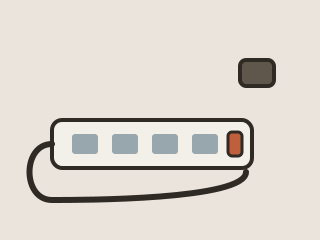
Surge protector with a long cord
Outlets are never where the furniture is. Look for internal overload protection, and note that the listing conditions for these taps say they are not to be connected to one another or to an extension cord.
Seen in: Useful Housewarming Gifts: The Three Reliable Lanes
View on AmazonNew home essentials that pass the five-minute test
Start with safety, where the test matters most. A battery-powered smoke alarm and a carbon monoxide detector unbox, mount, and watch the household the same evening. The history here is blunt. The National Institute of Standards and Technology's 2024 fire history counts homes with a smoke alarm at 10 percent in 1975. This rose to at least 92 percent in 2000, with fire deaths cut by about half.
Add a fire extinguisher on the same trip, stowed near the kitchen. The toolkit can wait a day; the detectors cannot.
A broom and dustpan set earns its spot the first evening, after the movers leave. That is also why stores charge a moving-week markup for it. Buy it before the move and skip the premium.
A surge protector with a long cord fixes the other certainty: outlets never land where the furniture lands. Check the listing for internal overload protection, and read the conditions, which bar connecting these strips to one another or to an extension cord.
One task fails the five-minute rule and stays anyway: re-keying the locks. It needs a locksmith's schedule, and it still happens before the first night.
The five-minute test, our suggested version:
- Unbox it. If opening takes longer than five minutes, it goes back unopened.
- Count the tools. Anything past a screwdriver is a week-two job.
- Name tonight's use. Sleeping, eating, cleaning, or locking up; otherwise it waits.
- Check the return. Buy the version a store will take back.
- Assign a spot. No spot yet means it waits.
Kitchen and bath essentials you can set up in five minutes
The kitchen needs one of everything, unboxed by dinner. One pot, one skillet, one chef's knife, one cutting board, a spatula, tongs. That is a real dinner, not camping food.
The budget case is real too. The U.S. Bureau of Labor Statistics' 2024 spending release sized average yearly food spending at $10,169 per household, and week one is when the takeout habit takes root. A pot and a knife are the cheapest interruption available.
Coffee maker now; microwave later. A coffee maker unboxes, rinses, and brews inside five minutes, while a microwave demands a counter decision the counters cannot answer yet.
If the kitchen has no dishwasher, a dish drying rack is the fix. It is free-standing, needs no installation, and works the first evening there are dishes. Check the listed footprint against a small counter before you click.
The refrigerator water filter is the least glamorous item here and the one nobody buys for themselves in a first month. Every fridge that takes one needs one. Match the model number on the listing to the appliance, because near-misses either do not fit or do not seat.
The bath runs on free-standing fixes. A stackable laundry basket needs no wall and no hardware, which matters when a closet is the only storage in the unit. Add towels, then a flange plunger for the toilet; the cup style is for sinks, and the folded lip is the difference.
Buy-now vs. buy-later: the comparison table
The entry gets one line here: an entryway key tray is the smallest buy-now item, because the entry is the room with nowhere to put anything. The buy-now column below is our judgment, applied item by item against the five-minute test. Price bands and calls are ours, not a sourced figure.
| Item | Buy now (passes the five-minute test) | Wait until week two |
|---|---|---|
| Safety | Battery smoke and CO detectors; fire extinguisher by the kitchen | Hardwired or pro-installed units |
| Tools | Hammer, screwdrivers, tape measure, pliers; re-key locks move-in day | Drill and specialty tools |
| Cleaning | Broom and dustpan set, all-purpose cleaner, sponges | Vacuum and mop |
| Kitchen | Pot, skillet, chef's knife, cutting board, utensils, coffee maker, dish drying rack | Microwave, toaster, the rest of the appliance shelf |
| Bedroom | Sheets, pillows, comforter | Bed frame; the mattress sleeps fine on the floor |
| Bath and laundry | Towels, flange plunger, stackable laundry baskets | Storage bins, closet organizers |
| Entry and power | Entryway key tray, surge protector with a long cord | Smart thermostat, anything wall-mounted |
The waiting column has a logic of its own. A smart thermostat waits on scheduling alone: the EPA's ENERGY STAR smart thermostat FAQ treats installation as a step whose requirements vary by system. Storage bins wait because nobody knows what needs storing until the boxes open.
One number frames the whole list. The bureau's 2024 spending data put housing at $26,266 in average yearly spending, and the first week's cart is a rounding error against it. Calm beats cheap here.
Our take: The five-minute rule is really a calm-spending rule. The gear that passes it is cheap, dull, and impossible to substitute. This is why stores charge a premium to people mid-move; buying it ahead, at normal prices, is the whole play. The call differs for renters: skip anything bracket-mounted, and spend the saved afternoon booking the locksmith instead.
First-week FAQ
What should go in a first-aid kit for a new home?
How much time should I spend labeling the circuit breaker panel?
Plan on half an hour with two people: one flips breakers while the other labels rooms as lights die. It is a week-two task. Photograph the open panel first, in case the printed legend is missing.
What is the average cost breakdown for new home essentials by room?
No sourced per-room breakdown exists, so here is our read: the kitchen dominates a first-week cart,