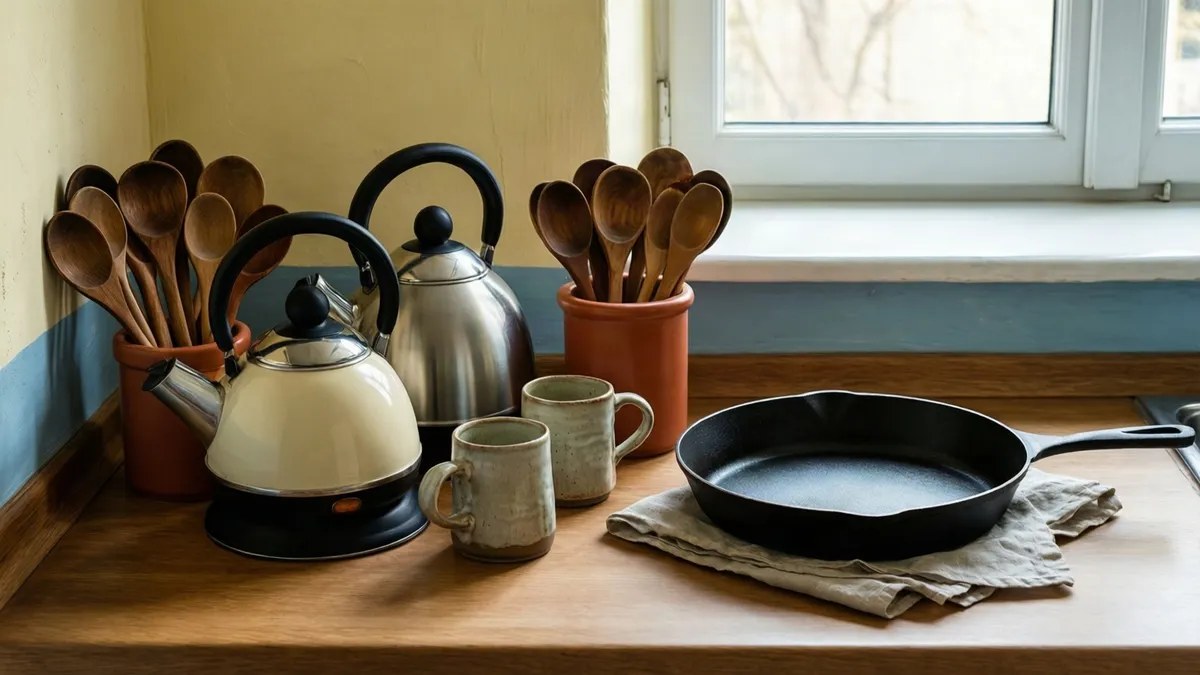
In short: Two people moving in together arrive with two of everything cheap and one good version of nothing. So the gift that lands is one of two things. The single good replacement for a matched pair of mediocre ones, or the genuine second of something a two-person home needs twice. Treat the couple as a household. Buy for the storage they have, not the square footage.
We write buying guides, not lab reviews: nothing on this site has been tested, handled or photographed by us. Prices, availability and ratings change constantly — whatever Amazon shows when you click is the authoritative figure.
Two of everything, one of nothing
Merging two households is mostly an exercise in subtraction. Two can openers arrive, neither of them sharp. Two sets of drinking glasses arrive, both of them partial. Two floor lamps arrive, each bought in a hurry for an apartment that no longer exists.
What does not double is the storage.
The U.S. Census Bureau's Survey of Construction reports the median size of completed multifamily units built for rent at 1,000 square feet. Its figure for the median completed single-family home is 2,142 square feet. Either way, the merged home has one kitchen, one linen closet and one hall closet. Duplicates show up regardless.
Household size fills in the rest of the arithmetic. The Census Bureau's historical households table gives an average of about 2.5 people per household for 2025. Two people is close to the whole of a typical American household. Homes are sized around that count, while the duplicates arrive uninvited.
One of each pair has to lose, and the loser goes somewhere specific.
The Environmental Protection Agency's most recent published figures, for 2018, put generation of furniture and furnishings in municipal solid waste at 12.1 million tons. Of that sector, the agency states, the majority — 80.1 percent — was landfilled. Small appliances came to about 2.2 million tons the same year, and only about 5.6 percent of that was recycled.
Textiles follow the pattern. Again for 2018, the agency's most recent published figures put textile generation at 17 million tons, with a recycling rate of 14.7 percent and 11.3 million tons sent to landfills.
None of that is an environmental argument. It is a description of what happens to the towel set that loses, which is worth knowing before adding a third one. This site sorts every gift by taste risk, and the three-lane version of that argument applies here unchanged. Merging just makes one lane much stronger than usual.
Buy the one good replacement
Here is the shape of the gift. Find something the merged household now owns two mediocre copies of, and buy the good single version. Two things go out, one comes in, and the storage math improves.
Each pick below is argued from something printed on the listing or the label, because you have probably seen the new place once, in photos, or not at all.
This article contains affiliate links. If you buy through one, we earn a small commission at no extra cost to you. We only recommend what we would suggest to a friend.
Lighting a corner the ceiling misses
Most rentals are lit from one fixture in the middle of the ceiling, so both people already own a lamp bought to fix that. Neither lamp was chosen carefully. Lighting is therefore the easiest replacement in the home, and it needs no drill.
Evidence for this pick lives in the bulb.
The U.S. Department of Energy's Federal Energy Management Program guidance on purchasing energy-efficient light bulbs states that ENERGY STAR-qualified bulbs must have a color rendering index of 80 or greater. That same guidance says qualified bulbs are required to last 10,000 hours or more.
Color rendering index describes how accurately a light source shows the colors of what it falls on. Eighty is the qualification floor, which makes it the number to shop at or above. Rated hours matter for a duller reason: a bulb nobody has to think about for years is a lamp that stays in use.
Browse floor lamps on Amazon, then pair one with high CRI LED bulbs.
Drying off, twice a day, for years
A merged linen closet holds two towel sets and room for one. Its label decides which set stays, and it carries a line most people never read.
Under the Textile Fiber Products Identification Act, at 15 U.S. Code § 70b, a label names each fiber by its generic name. They appear in order of predominance by weight, and only where a fiber is 5 percent or more of the total fiber weight.
Anything below that line is handled by 16 CFR § 303.3. No fiber present in an amount under 5 percent of total fiber weight may be named at all; it has to be designated as "other fiber."
So "other fiber" is not the seller being vague. It is a component nobody is required to identify.
That is exactly the line to check when a household is deciding which of two towel sets to keep, and the line to check on the set you are buying. Sets that state one fiber at 100 percent leave no such gap.
Compare Turkish cotton bath towel sets on Amazon on that line first.
Pouring water for four people
Two partial sets of drinking glasses do not add up to one set. They add up to a cabinet where nothing matches and the two survivors of the better set are always in the dishwasher.
A single set of twelve, in one shape, ends that. Tumblers in a single size stack in the cabinet, get replaced individually when one breaks, and stop being a decision every time somebody reaches up.
Look at drinking glass sets of 12 on Amazon.
Setting a table for more than two
Flatware merges worse than anything else in a kitchen. Two opened sets of service for four produce a drawer holding eleven forks, three teaspoons and a single steak knife.
Service for eight in one pattern is the replacement, and quantity is genuinely the point of it. It also covers the evening four people eat at the table, which two half-sets never quite manage.
See flatware sets in service for 8 on Amazon.
Draining last night's dishes
Both households owned a plastic dish rack. Both racks are already stained, because a rack sits on the counter, gets wet daily, and is the object a household replaces last.
Stainless steel with a removable drip tray outlives the merge. Check the width against the counter run before buying, since that is the one dimension the listing states and the buyer forgets.
Here are stainless steel dish drying racks on Amazon.
Applied to a household of any size, the specification-led version of this exercise gets its own guide to useful housewarming gifts.
The genuine second one
Underneath that sits the quieter half of the merge. Some objects a two-person household needs two of, and it owns exactly one, because the one arrived with whichever person owned it first. Nobody notices until both people need it at 7 a.m. on the same Tuesday.
Insulated travel mugs are the clearest case. One mug, two people leaving at once: whoever reaches the cabinet first has coffee, and the other buys a paper cup on the way. Buying a matching second mug costs less than most decor, and it never has to be displayed. Browse insulated travel mugs on Amazon.
Pillows are the second one nobody files as a second one. A bed holds two sleepers with two different firmness preferences, and the household bought one pair, in one firmness, on one afternoon. Buying the other firmness is a purchase that would otherwise wait years. Look at bed pillow 2-packs on Amazon.
Seating hits its ceiling at exactly two in most merged homes, because two chairs came from one apartment and the rest were left behind. A pair of folding chairs that stores flat in a closet turns dinner for two into dinner for four, then disappears again. See folding dining chairs on Amazon.
Last, unglamorous and cheap: a second pair of oven mitts. With one pair, only one hot pan moves at a time.
The overview guide names this lane and works through the household-of-one case. What changes with two people is only the arithmetic, which gets more obvious.
Who you are actually buying for
A couple is a household. That is the entire assumption you need, and it is worth stating because gift lists in this category tend to assume a good deal more.
On December 2, 2025, the Census Bureau released new estimates on America's families and living arrangements, drawn from the Current Population Survey Annual Social and Economic Supplement. Fewer than half — 47 percent — of U.S. households in 2025 were married couples, it reports.
That same release counts 39.7 million one-person households in 2025, 29 percent of all households, up from 20 percent in 1975.
Couple households are varied inside that share.
Analyzing the 2021 American Community Survey, the Census Bureau found opposite-sex married couple households at 86.8 percent of coupled households, and opposite-sex unmarried partner households at 11.6 percent. A separate Census Bureau analysis of 2024 American Community Survey one-year estimates counted about 1.4 million same-sex couple households, nearly double the number in 2005.
What that adds to a shopping decision is one instruction: buy for the address. Married or not, the two people at the party run one home, with one kitchen and one linen closet. You do not need to know who cooks or who does laundry. You need to know how many of a thing the home already holds.
Whether they rent or own changes the square footage in the figures above and nothing else about the instruction. Renting a merged home and owning one produce the same duplicate problem in the same week.
The one good version is the deferred purchase
There is a reason the good replacement works as a gift.
The Federal Reserve Board's Survey of Household Economics and Decisionmaking was conducted in October 2025. Its report, published May 13, 2026, states that 63 percent of adults would cover a $400 emergency expense using cash or its equivalent, unchanged from 2024.
That is a national figure about a hypothetical expense. It says nothing about the household you are buying for, and no conclusion about them should be drawn from it.
It describes a category of purchase, no more. Replacing two working towel sets with one better set carries no deadline, and things with no deadline are what a newly merged household puts off. Gifts skip the queue. Which objects hold up long enough to justify that is the subject of our guide to the best housewarming gifts.
Frequently asked questions
What is a good housewarming gift for a couple moving in together?
Buy the single good version of something they now own two cheap copies of. Glassware, flatware, towels, a floor lamp, a dish rack. Two mediocre objects leave the home and one good one arrives, so the gift does not compete for storage. Otherwise, choose the genuine second of something a two-person home needs twice.
Do you bring one gift or two to a couple's housewarming?
One. Housewarming gifts go to the household rather than to each person in it, and the occasion is about the home. If you want to spend more, spend it on one better object instead of two smaller ones. Two gifts also double the number of things somebody has to find room for. Whether a gift is expected at all is a separate question, and we answer it in do you bring a gift to a housewarming party.
What do you get a couple who already owns everything?
Owning everything almost always means owning one of everything, so look for the object that only works in pairs. Travel mugs, pillows in a second firmness, oven mitts, chairs. None of these gets declined, because none of them asks for a style match or a shelf. Ask someone who has been inside the home which object gets fought over.
What does "other fiber" mean on a towel label?
It means a fiber making up less than 5 percent of the total fiber weight. Under 16 CFR § 303.3, such a fiber may not be named by its generic name at all and has to be designated "other fiber." Sets stating a single fiber at 100 percent leave nothing unnamed, which is worth knowing when a household is choosing between two sets.
What should you look for in a light bulb for a lamp you are giving?
Color rendering index and rated life. The Department of Energy's Federal Energy Management Program guidance sets both. ENERGY STAR-qualified bulbs must have a color rendering index of 80 or greater, and qualified bulbs are required to last 10,000 hours or more. Buy the bulbs with the lamp, since a lamp arriving without them becomes an errand.
Is it rude to replace something a couple already owns?
Not when they own two of it. Duplicates are the one case where a replacement gift removes work, and the household was already going to lose one of the pair. Say plainly that a gift receipt is in the box. Avoid replacing anything either person chose deliberately or has had a long time.
Iris Calder is the editor of Housewarming Gift Ideas and a former residential move manager. Nothing named here has been tested, handled or photographed by us; the figures are the publishers' own. How we work is on the about page, her author page has the rest, the affiliate disclosure covers the funding, and the products page lists the categories we point to.
Sources
- U.S. Census Bureau, "Census Bureau Releases New Estimates on America's Families and Living Arrangements," release CB25-TPS.78, December 2, 2025, from the Current Population Survey Annual Social and Economic Supplement. https://www.census.gov/newsroom/press-releases/2025/families-and-living-arrangements.html — retrieved 2026-08-20.
- Laquitta M. Walker and Lydia R. Anderson, U.S. Census Bureau, "Married Couple Households Still the Majority but Share Varied by Geography in 2021," March 26, 2024, American Community Survey 2021. https://www.census.gov/library/stories/2024/03/coupled-households.html — retrieved 2026-08-20.
- Nestor Hernandez and Barbara Pham, U.S. Census Bureau, "More Female Than Male Same-Sex Couple Households in the United States in 2024," April 1, 2026, American Community Survey 1-year estimates. https://www.census.gov/library/stories/2026/04/same-sex-couples.html — retrieved 2026-08-20.
- U.S. Census Bureau, Table HH-6, "Average Population Per Household and Family: 1940 to Present," Historical Households Tables; index page last revised December 2, 2025. https://www.census.gov/data/tables/time-series/demo/families/households.html — retrieved 2026-08-20.
- U.S. Census Bureau, "Highlights of 2025 Characteristics of New Housing," Survey of Construction, no date shown on page. https://www.census.gov/construction/chars/highlights.html — retrieved 2026-08-20.
- U.S. Environmental Protection Agency, "Durable Goods: Product-Specific Data," Advancing Sustainable Materials Management, page last updated October 23, 2025, reference year 2018. https://www.epa.gov/facts-and-figures-about-materials-waste-and-recycling/durable-goods-product-specific-data — retrieved 2026-08-20.
- U.S. Environmental Protection Agency, "Textiles: Material-Specific Data," Advancing Sustainable Materials Management, page last updated March 19, 2026, reference year 2018. https://www.epa.gov/facts-and-figures-about-materials-waste-and-recycling/textiles-material-specific-data — retrieved 2026-08-20.
- Board of Governors of the Federal Reserve System, "Federal Reserve Board issues Economic Well-Being of U.S. Households in 2025 report," May 13, 2026, from the Survey of Household Economics and Decisionmaking conducted in October 2025. https://www.federalreserve.gov/newsevents/pressreleases/other20260513a.htm — retrieved 2026-08-20.
- "15 U.S. Code § 70b — Misbranded and falsely advertised textile fiber products," Textile Fiber Products Identification Act, no date shown on page; text retrieved from the Cornell Law School Legal Information Institute. https://www.law.cornell.edu/uscode/text/15/70b — retrieved 2026-08-20.
- "16 CFR § 303.3 — Fibers present in amounts of less than 5 percent," no date shown on page; text retrieved from the Cornell Law School Legal Information Institute. https://www.law.cornell.edu/cfr/text/16/303.3 — retrieved 2026-08-20.
- U.S. Department of Energy, Federal Energy Management Program, "Purchasing Energy-Efficient Light Bulbs," guidance updated June 2023. https://www.energy.gov/cmei/femp/purchasing-energy-efficient-light-bulbs — retrieved 2026-08-20.