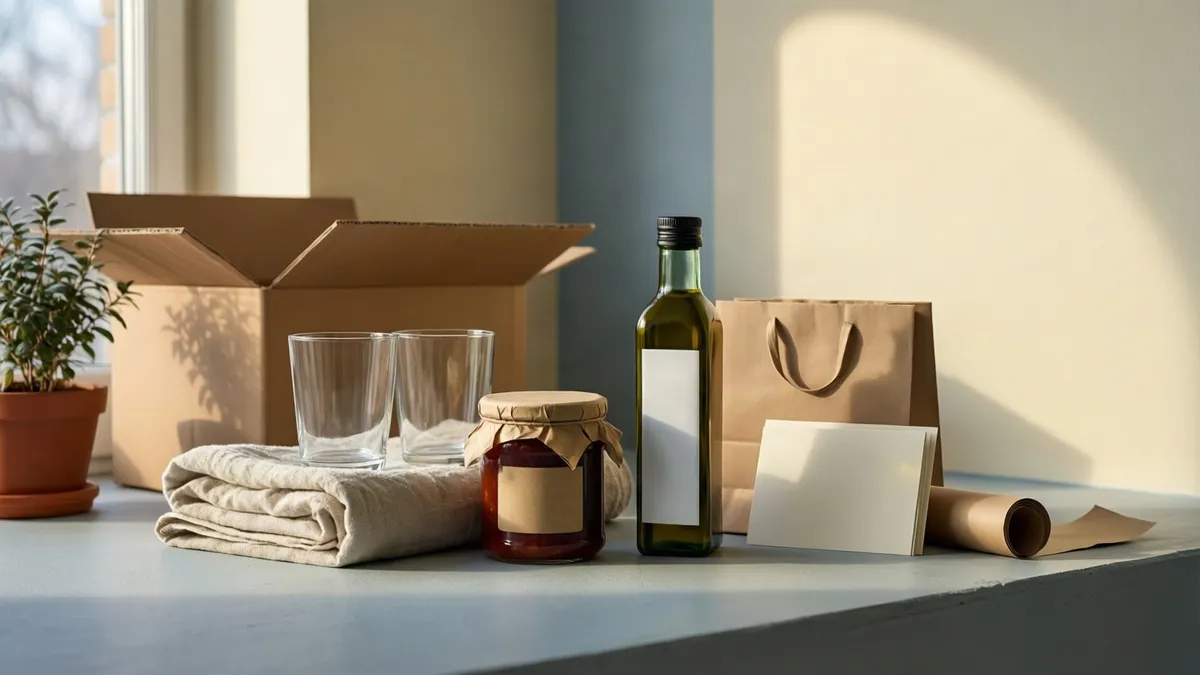
In short: At a holiday party you are not buying a housewarming gift and a hostess gift. You are buying one gift that gets opened, used or eaten that night and still earns its place in January. Spend under $30 for a neighbor's open house or a coworker, $50 to $100 for a close friend, and let the relationship set the tier rather than the wrapping. Carry anything edible or drinkable in hand, send the rest to arrive before the party, and let the card carry the second thank-you.
We write buying guides, not reviews: nothing on this site has been tested, handled or photographed by us. Specs come from the manufacturer or the listing. Whatever Amazon shows when you click is the authoritative figure.
This article contains affiliate links. If you buy through one, we earn a small commission at no extra cost to you. We only recommend what we would suggest to a friend.
The Federal Trade Commission's endorsement guides, 16 CFR Part 255, require a disclosure like that one to be difficult to miss, so it sits above every link here. Our full affiliate disclosure has the rest.
December stacks two occasions on one doorstep. The housewarming used to get its own card and its own casserole; now it shares the night with the party. The general playbook lives in Housewarming Gift Ideas That Don't Guess at Their Taste. This piece applies it to the hardest version: one invitation, two thank-yous, one trip from the car.
The test is simple and unforgiving. A gift that works gets used before the night ends and still has a job in January. A gift that fails one half becomes clutter. A gift that fails both becomes someone else's re-gift.
What we measured: We read the 13 ranking pages for this search in full; one more would not load. Of the 13, only two answer the host-gift question directly, and none sets a spend by relationship. In our comparison, the prices they quote run roughly $14 to $119, with a median near $41 across 172 price mentions. Prices came from the guides as written, not live listings, so treat that band as a one-day snapshot.
Why the holiday party merges two gifts into one
Two boxes at one door is a sales pitch, not an etiquette rule. A hostess gift thanks the evening. A housewarming gift congratulates the walls. When the party is itself the housewarming, both messages land on the same doorstep, and the second box mostly ends up re-wrapped in someone else's January.
Check who is actually hosting before you double anything. Gallup's 2026 poll found 61% of Americans say they own their primary residence, while 34% rent, so roughly one December host in three does not own the walls being celebrated. The same poll found 25% of non-homeowners expect to buy within five years, the lowest reading since the question began in 2013. The classic first-house party is rarer than the gift aisle assumes.
New building does not rescue the count. The U.S. Census Bureau's July 2026 release put privately-owned housing completions at a seasonally adjusted annual rate of 1,212,000, which was 16.8 percent below July 2025. Fewer finished houses means more of these parties in apartments, where a second box has nowhere to land.
So one object, two jobs. Our test, applied in Do You Bring a Gift to a Housewarming Party? and every guide since: will the household use it before the night ends? Will it still be there in January? Pass both and the object covers the whole obligation. The card carries the thanks.
How much to spend on a holiday housewarming gift
Spend follows the relationship, never the wrapping. The backdrop matters: Gallup's 2026 survey found 67% of U.S. adults think now is a bad time to buy a house. The same poll's April 1-15 field period put the median U.S. home price near $409,000. Plenty of hosts stretched for those keys. The gift's job is the night, not a matching contribution to the mortgage.
Here is how we would sort it:
| Who you're shopping for | Our spend band* | The housewarming half | The host half | Does a card alone do it? |
|---|---|---|---|---|
| A close friend's first party in the new place | $50 to $100 | One durable object they would not buy themselves: a pair of good glasses, a better kitchen tool | The same object, opened at the party | No |
| A neighbor's open house | Under $30 | Something eaten or poured that night | The same thing; it never needs a shelf | Yes, if the card carries the congratulations |
| A coworker's holiday gathering | Under $30 | A consumable for their own kitchen, not the shared break room | The same object, handed over | Yes |
| A host you already gifted at move-in | Nothing owed | The earlier gift | A card, or a small edible if you want one | Yes, the debt is paid |
*Spend bands are our editorial judgment, not a sourced figure.
Our take: The two-gift etiquette is where budgets break, so our call is one object at the top of your tier instead of two at the bottom. The call flips only for the host you already gifted at move-in, where a second present reads as bookkeeping and the card alone is the honest move.
Send it ahead or carry it in, decided by whether it is food
Food decides the timing.
Anything edible or drinkable travels in your hands, at room temperature, because it is either part of the table that night or ruined by the trip. Perishables cannot sit in an apartment lobby waiting for someone to come down.
Everything else goes the other way. A package that arrives before the party lands as a housewarming gift in the new home, unpacked without an audience, instead of competing with a cheese board for attention. It also spares the host one thing to carry home in the cold.
Our working order for the whole decision:
- Pick the tier from the relationship first; the spend band follows.
- Choose one object that works tonight and survives into January.
- Screen the household: pets, kids under five, renters.
- If it is edible or drinkable, carry it in hand at room temperature.
- If it is not food, send it to arrive two days before the party.
- Tape the card on top so both jobs share one line.
- If you gave a move-in gift, stop at the card.
Holiday housewarming gifts that get used twice
Used up wins again. The sorting rule across this site, laid out in Housewarming Gifts That Don't Depend on Their Taste, puts consumables first because nobody has to find them a home. In the forum threads we read, the praise repeats for splurge-y elevated basics: fancy olive oil, aged balsamic, flaky salt, real maple syrup. One person put it plainly, that they "always go over well" because the recipient never has to store them.
Decor is the opposite bet.
The recurring complaint in those threads is clutter: candle holders, vases and wine glasses that "are not my taste and just take up room." A holiday party is the worst possible unveiling for that, with a room full of witnesses and no receipt in sight.
Candles need one line of care before they go in the bag. Per the National Fire Protection Association figure carried on the U.S. Fire Administration's candle fire safety page, 20 home candle fires are reported each day. The same federal page instructs keeping lit candles at least 12 inches from anything that burns. Our read: bring plain unscented tapers for tonight's table and skip jarred scented candles, which need a shelf and a clearing of their own.
For the host who owns everything, go narrower. A pair of heavy cocktail glasses gets reached for tonight. A small-batch olive oil empties by spring, and no cabinet has to make room for it.
What to write, and what to do if you already gave one
The card does the second job, which is why a card can close the whole obligation in the right row of the table. Put the congratulations inside the thank-you and both messages fit on one side. Our suggested wording, fill in the brackets:
"To the new keys at [street or neighborhood]. May the [kitchen] be the first room that feels finished. Thank you for having us tonight. — [your name]"
If you already gave a gift at move-in, the debt is paid. The first gift covered the walls, and etiquette does not run a tab. Sign the card, or bring a small edible if arriving empty-handed feels wrong to you.
Calibrate by tier, not by guilt. The neighbor's open house runs fine on cards and a bowl of something, while the close friend's party is where the bigger object belongs.
How far ahead should a shipped housewarming gift arrive?
Two to three days before the party. That buffer absorbs one missed December delivery day and lets the host stash the box unopened. A package landing the morning of the party defeats the point of shipping it at all.
Are candles or plants safe to give if the host has pets?
In the forum threads we read, the repeated caution is pet toxicity: check before gifting plants, flowers or candles, so nobody's cat or dog ends up at the emergency clinic. The American Society for the Prevention of Cruelty to Animals (ASPCA) publishes a list of plants toxic to cats and dogs, which includes several sold as easy gift plants. In doubt, bring food.
Is a bottle of wine a lazy host gift?
Not if you know they pour it. Wine fails in two specific cases: a household that does not drink, and a party that is already stocked. The safer default is the pantry bottle that works either way, or good glassware that outlasts the night.
Should the gift change if the host rents?
Yes, quietly. Nothing that mounts, drills or demands a permanent fixture, because move-out ends with somebody patching holes. A renter-safe gift stands on a counter, burns in one evening, or empties completely.
Iris Calder writes buying guides, not reviews; nothing here was tested by us.
Sources
- Federal Trade Commission — "Guides Concerning the Use of Endorsements and Testimonials in Advertising (16 CFR Part 255)" (https://www.ftc.gov/legal-library/browse/federal-register-notices/guides-concerning-use-endorsements-testimonials-advertising) "Retrieved 2026-09-12"
- Gallup — "Homebuying Intentions Decline Further in U.S." (https://news.gallup.com/poll/708995/homebuying-intentions-decline-further.aspx) "Retrieved 2026-09-12"
- U.S. Census Bureau — "Monthly New Residential Construction, July 2026 (CB26-127)" (https://www.census.gov/construction/nrc/current/index.html) "Retrieved 2026-09-12"
- U.S. Fire Administration — "Candle Fire Safety" (https://www.usfa.fema.gov/prevention/home-fires/prevent-fires/candle/) "Retrieved 2026-09-12"