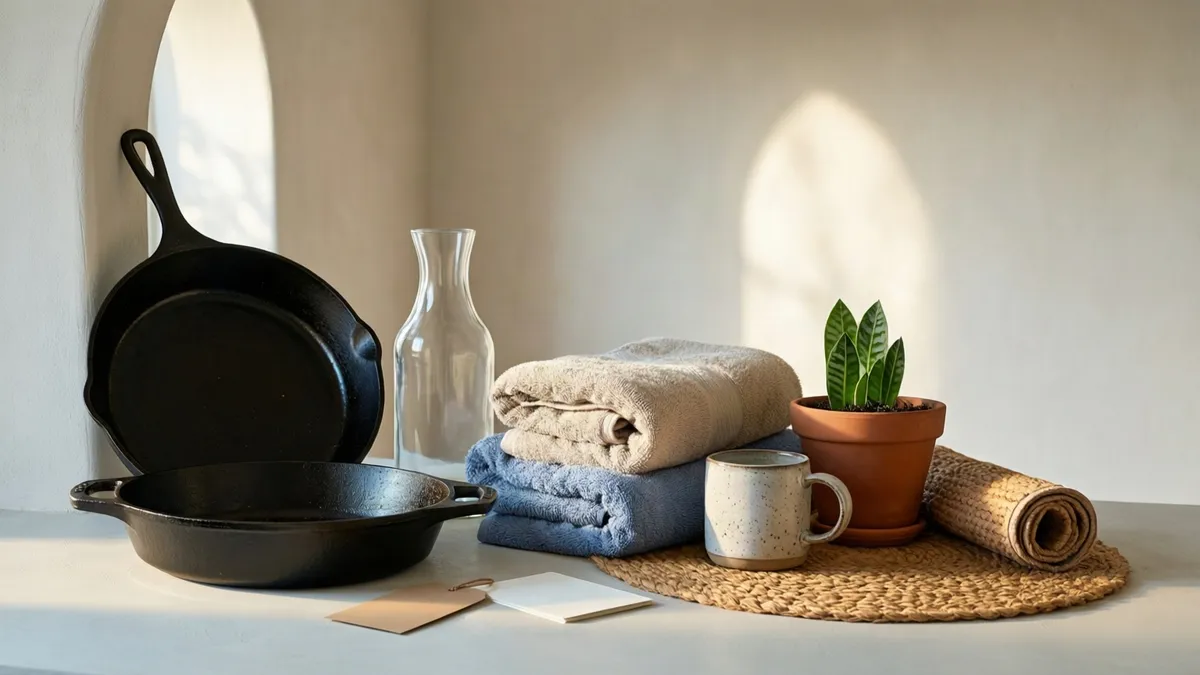
In short: Search "housewarming gift ideas for men" and the shelf hands you whiskey stones and masculine-scented candles. Sort the same candidates by use and most of them survive the move. Three tests decide nearly every pick. It gets used up, it upgrades something he touches daily, or it is the second one of a thing a household only owns one of. "For men" changes default sizes and duplicate risk, not what makes a housewarming gift good.
We write buying guides, not reviews: we have not used these items. Specs come from the manufacturer or the listing, and whatever Amazon shows when you click is the authoritative price and figure.
This article contains affiliate links. If you buy through one, we earn a small commission at no extra cost to you. We only recommend what we would suggest to a friend.
The Federal Trade Commission's endorsement guides, 16 CFR Part 255, require a disclosure like that one to be difficult to miss, so it sits above every link here. Our full affiliate disclosure has the rest.
Men are not hard to buy for. The search phrase is the problem: "gift ideas for men" is a merchandising shelf, and shelf logic sells an identity rather than a gift. That is how the whiskey stones end up in a drawer by October.
Sort the same candidates by use and the shelf becomes a shortlist. The phrase "for men" really changes two variables: default sizes, and duplicate risk, because the stereotyped categories are the ones he has already been given. Everything else is the same question our pillar, Housewarming Gift Ideas That Don't Guess at Their Taste, asks of every recipient.
What we measured: We read the 8 ranking pages this search returns in full; one more would not load. Six of the eight we analyzed cover kitchen gear, candles, and alcohol, and prices quoted across them run roughly $18 to $200, with a median around $55 in our comparison. Almost none sorts its picks by how the gift gets used. Prices were as quoted in those guides, not live listings, and the snapshot is one day old.
The "for men" filter sorts by identity. Sort by use instead
Type the query and a shelf appears: whiskey stones, a grill apron, a candle labeled like cologne. The shelf sells an identity back to the buyer. Identity is exactly what a gift cannot survive, because it asks him to display a personality you guessed at.
Sort by use and twenty-five real picks come out of the same category. Only two variables in the query are actually about men: sizes run larger by default, and duplicate risk is high. Both are answerable with one text message. Nothing else about "for men" changes what a housewarming gift is for.
Three tests that decide almost every pick
A gift gets used up, or it upgrades an object he touches daily, or it is the second one of a thing the household owns exactly one of. Everything below is a test result, not a mood. The same three lanes carry our guide to useful housewarming gifts for any recipient.
Run them in order. Our suggested pre-purchase checklist, fill in before you buy:
- Which room does it land in?
- Which test does it pass: used up, daily upgrade, or second one?
- Does he already own one? Ask, or ask someone who has seen the place.
- Is the default size right for a household of one or two?
- Would a renter have to drill, mount, or wire it? If yes, stop.
- Does it need a flame, a wall, or a pet-safe plant check?
Judge candidates by the room they land in. E-commerce accounted for 17.1 percent of total U.S. retail sales in the second quarter of 2026, per the U.S. Census Bureau's report of August 18, 2026. So for most buyers, the listing is the store aisle. That is why the spec column stays in listing language, and the two judgment columns are ours.
| Room | Test it passes | Typical price band* | Spec that decides it, as the listing states it | Taste risk* |
|---|---|---|---|---|
| Kitchen | Second one | $25–$70 | pre-seasoned, oven-safe, diameter in inches | Low |
| Bar | Second one | $20–$80 | lead-free glass, capacity in ounces, dishwasher-safe | Low |
| Coffee | Daily upgrade | $15–$100 | capacity in cups, filter type, carafe material | Low |
| Entry | Used up / daily upgrade | $20–$50 | size in inches, non-slip backing, indoor-outdoor rated | Low |
| Bath | Daily upgrade | $30–$80 | cotton type, weight in GSM, towel size | Low |
| Living room | Second one / daily upgrade | $25–$90 | fabric, fill, machine-washable | Medium |
| Balcony | Second one | $30–$150 | capacity in quarts, rust-resistant finish | Medium |
*Price bands and taste-risk ratings are our editorial judgment, not a sourced figure. Check the listing for live specs.
Our take: Our call is to buy from the second-one column first, because one good object added to a household beats one more thing parked on a counter. The used-up tier wins for anyone you see rarely and for first apartments. Skip the bar column's masculine-marketed sets entirely: the plain decanter passes, the engraved "man cave" version fails.
The second one: gifts for things a household only owns one of
Start with the highest ceiling. A household owns one cast-iron skillet, one good chef's knife, one set of everyday glasses, maybe one decanter. The second of any of these goes to work the week it arrives. A pre-seasoned cast iron skillet outlasts the lease, and an 8-inch chef's knife upgrades every meal he cooks.
The duplicate check is the whole trick. Ask him, or ask whoever has seen the kitchen, before you buy a decanter or a second set of drinking glasses. The forum version of this question asks whether glassware is enough alone. Pair it with the bottle: the glasses pass the second-one test, the bottle passes used-up.
Coasters are the low-cost version, wool felt rather than monogrammed leather. A backgammon set counts too, because a household owns one or none. Tools are the exception people argue about, and the answer is scope: a basic kit passes for a first apartment, while power tools are where duplicate risk lives.
Used up by spring: the zero-risk tier
Nothing to store, nothing to match, nothing to return. When you have never stood in the room, shop here. Good olive oil, a gourmet spice set, tinned fish, coffee beans from a roaster he would not splurge on, loose-leaf tea.
Alcohol belongs here with one honest caveat. A bottle of wine is the safe default, and safe defaults are boring; the fix is pairing, not abandoning. A bourbon or rye he would not buy for himself clears the wouldn't-buy-it-himself bar. Hand soap counts as well: a duo for the new kitchen sink is the least glamorous pick here and among the most used.
One consumable carries a real caveat. The candle brings an open flame into a new home. Treat it as a fire decision first and a scent decision second, and give it only when the household wanted one.
Upgrades to something he touches every morning
He touches the same few objects before noon: the coffeemaker, the faucet, the lamp switch, the towel. Upgrade one and the gift earns counter space on its own. A pour-over setup or French press is the entry point; a smart plug brings any lamp on before he is out of bed, no wiring required.
A freestanding lamp beats wall art, and not only on taste. It needs no drill, no anchor, no patching at move-out. Textiles do the same work in the bath: a dense bath towel set, with the weight in GSM stated on the listing, or a robe for winter mornings. Then the small things he will not buy himself: a wool throw for the couch, house slippers, a sunrise alarm clock, a smart speaker for the kitchen counter. This tier satisfies the "something he wouldn't buy for himself" rule without guessing at decor.
Where taste risk lives: scent, plants, art, and engraving
Four categories carry the risk, and they are the four the shelf pushes hardest. Scent is a stand-in-the-room call: a candle or reed diffuser works only if you have smelled the room. Treat masculine-marketed scents as a fact about the gift, not a fact about his taste.
Plants come with a hard check first. The American Society for the Prevention of Cruelty to Animals (ASPCA) publishes the authoritative list of plants toxic to cats and dogs, and several easy first houseplants are on it. If you cannot confirm whether a cat or dog lives there, pick something else. Books read as safe and often are not: a design book is decor, a cookbook gets cooked from. Engraving is the quiet risk, since a monogram or a set of address coordinates makes a gift unreturnable. Flowers fail every test here; they are gone in a week.
What not to give, and how to hand it over
Gag gifts age worst of anything on the shelf. The joke lasts a minute and the object lasts years. Clutter fails by definition, and so does anything "masculine" by marketing alone, which is stereotype with a price tag. Whether a gift is even expected is its own question. We answer it in Do You Bring a Gift to a Housewarming Party?
Presentation is simpler than the guides make it sound. Wrap it plainly, put the card on top, skip the engraving. Tuck a gift receipt into anything that is not food or drink: the receipt is not an insult, it is the duplicate check made physical.
If you can't attend, just met him, or it's a second home
Ship consumables when you cannot be there. Time the delivery for the party day or just after, skip glass, and put the note inside the box, since nobody reads a card aloud over a package. When you are truly late, a multi-brand digital gift card to a hardware store works.
New relationship: spend low, go used-up. Our comfort bands are under $30 for someone you have dated a month and $30 to $75 for a close friend. They cost up to about $150 for family, and those bands are ours. Nothing engraved, nothing for the walls, nothing that assumes a joint household; if he shares the place with a partner, our guide for couples setting up one home applies instead. For a retiree who downsized, storage is the constraint, so the used-up tier wins again. Bring something to a second home too, scaled down; weekend places burn through consumables faster than a main house. And sort by use, the same list works for a woman. Only sizes and duplicate risk are gendered.
Which housewarming gifts do men actually keep and use for years?
No publisher tracks 12-month retention for housewarming gifts, so nobody can quote you a share, us included. The honest proxy is the tests: things that get consumed, replaced, or touched daily survive, and identity objects rarely do. Ask him which kitchen item he has replaced twice, then buy its better version.
What are eco-friendly housewarming gift ideas for a man?
The used-up tier is inherently low-waste, since food and drink leave no object behind. Solid bar soap, coffee sold in refillable containers, and a wool throw avoid plastic altogether. A reconditioned secondhand cast-iron skillet is both the greenest and often the cheapest pick in the whole category.
What belongs in a from-scratch basket for a guy's first place?
Think hardware, not gifts: two plungers (one for the toilet, one for the sink), a small fire extinguisher, batteries sized to the smoke detectors, scissors, a wastebasket. Add a roll of quarters if the building runs coin laundry. Wrap none of it; a utility tote is the wrapping.
Does the gift change if he rents, or if it's his first place?
Renting rules out anything drilled, mounted, or hardwired, so freestanding versions only. A first place changes the opposite way: duplicates are unlikely, but closets are thin, so favor the used-up tier over the second one until you have seen the storage.
Fancy ingredients or a kitchen gadget: which is the better gift?
Ingredients fail nothing: they get used up and cost zero storage. A gadget is a one-function bet on how he cooks. It only wins when it replaces something he already uses, like a rice cooker for someone who eats rice daily. Default to the olive oil and the good tinned fish.
Iris Calder writes buying guides, not reviews; nothing here was tested by us.
Sources
- U.S. Census Bureau — "Quarterly Retail E-Commerce Sales Report, 2nd Quarter 2026" (https://www.census.gov/retail/ecommerce.html) "Retrieved 2026-09-27".
- Federal Trade Commission — "Guides Concerning the Use of Endorsements and Testimonials in Advertising, 16 CFR Part 255" (https://www.ftc.gov/legal-library/browse/federal-register-notices/guides-concerning-use-endorsements-testimonials-advertising) "Retrieved 2026-09-27".